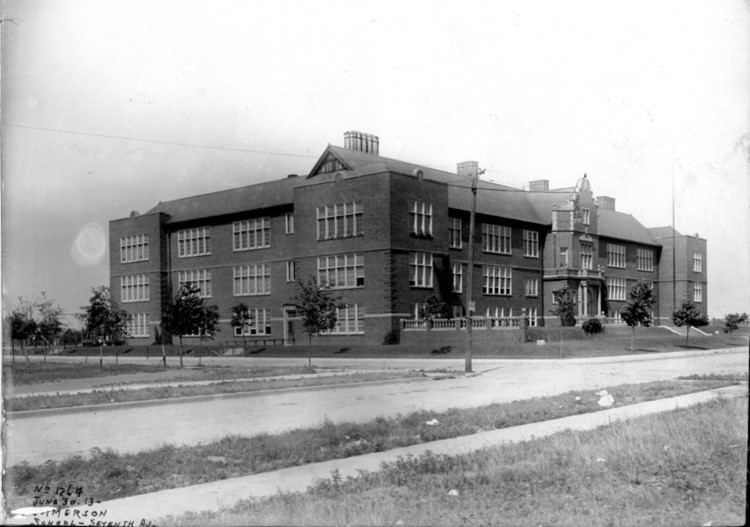
Gary was once a town with a thriving steel industry. While the city is often remembered today for its industrial decline, many may not realize that Gary has a deep connection to the development of American education during the early 20th century. It is the birthplace of the Gary Plan, an influential education reform aimed at creating a highly efficient public school system. This plan led to various school programs and organizational structures that are still evident in today’s education system, particularly the multi-period high school schedule, which is widely used across the country.
Emerson School is a three-story brick building constructed in 1908. It was a “work-study-play” school and one of the first five “Gary Schools” designed by the renowned school architect William Butts Ittner with input from school superintendent William A. Wirt, who established the Gary Plan. An article published in the 1910 School Board Journal praised Emerson School as “a building which shows in every feature the possibilities of such cooperation,” commending Wirt and Ittner for creating a school that exemplified the ideal American schoolhouse.
Ittner’s design aimed to utilize the “platoon” system – classes are divided into alternating groups to ensure that every department and room is occupied for as much of the eight-hour day as feasible. Wirt’s “work-study-play” program allowed the school building’s capacity to nearly double (Bourne, 1970). Together with the revamped educational system and purposefully designed facilities, Emerson School was able to accommodate a significant influx of students due to the booming steel industry.
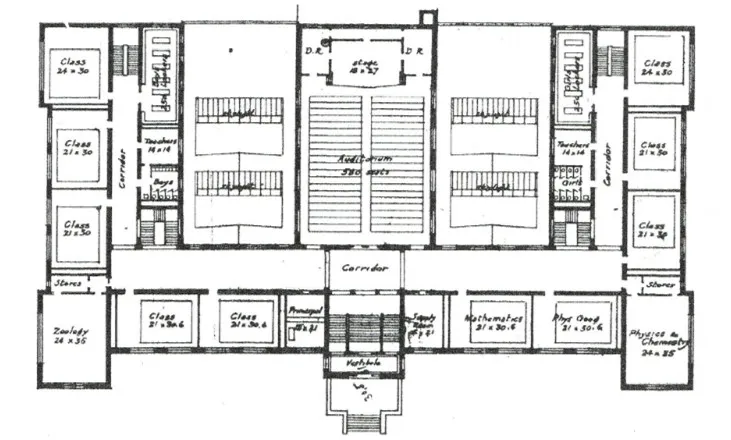
First Floor Plan of Emerson School (Photo from A Model American School, 1910)
The spacious hallways were a key feature of Emerson School’s design. Wirt believed these hallways should serve not only as corridors but also as art galleries or school museums for informal study. He envisioned schools incorporating features of museums and galleries so that children wouldn’t need to make special efforts to visit them. The wide and welcoming hallways were intended to enhance and beautify children’s daily lives while fostering their artistic sensibilities (Bourne, 1970).
Emerson School, as Wirt’s ideal school plan proposed, was surrounded by ten acres of open space. This included a playground equipped with apparatus, tennis courts, ball fields, running tracks, and handball courts. Additionally, there were two acres dedicated to a school garden and a cluster of cages and houses for the animals of the school zoo.
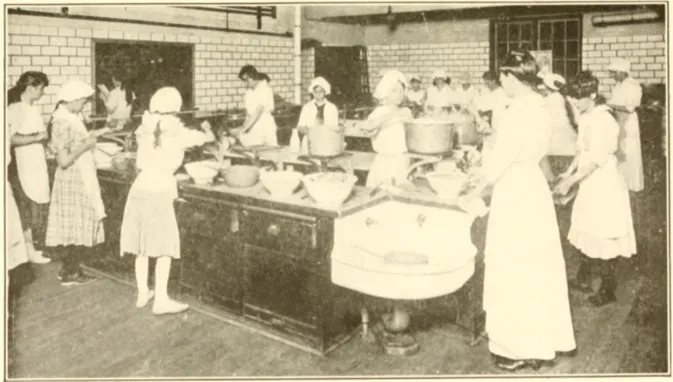
Cooking Room at Emerson School (Photo from The Gary Oublic Schools; Household Arts, 1918)
Students at Emerson School engaged in a comprehensive gardening project throughout the school year. For example, sixth-grade students were responsible for harvesting and distributing all edible crops for home use, domestic science projects, sale, and winter storage. The practice of harvesting crops for sale was part of Wirt’s vision of creating a self-sustaining school community. Furthermore, domestic science at Emerson was not regarded simply as a subject but as part of the self- sustaining practice. This involved the management of the school cafeteria by a cook assistant and an instructor. The domestic science room served as a functional kitchen, dining area, and pantry where teachers and students could prepare and eat daily meals. The daily tasks in domestic science for the girls involved collaboration with the teacher and cook. In 1981, Emerson School closed as a high school due to declining enrollment. However, a performing arts program called the Emerson Visual and Performing Arts High Ability Academy was later established in the facility, marking one of the first programs of its kind in Indiana. After several decades, Emerson School began to lead educational trends once again. The building was abandoned in 2008 due to a lack of funding and severe mold issues. Though the former Model American School – Emerson School came to an end of its service, Wirt’s “work-study-play” program and his efforts made in Gary schools are still influencing American school’s organization and curriculum today. Schools across the country still use the multi-period high-school schedule, vocational-career education programs, and arts curriculum offerings.
References
Bourne, R. S. (1970). The Gary Schools. M.I.T. Press.
A Model American School. (1910). School Board Journal, Vol. XL(No.6).
White, E. W. (1918). The Gary Public Schools; Household Arts. New York City, General Education Board. [Pdf] Retrieved from the Library of Congress, https://www.loc.gov/item/19001759/.