Last summer break, I spent the entire summer with my family, particularly my mother and grandmother, in Guangzhou. This reunion was significant due to the COVID policy and the expensive flights, as it marked the first time I had seen my family since 2020. When I expressed concerns about the high cost of the flight ticket and mentioned my financial dependency on my mother, she responded that she simply missed me and wanted to see me in person.
I’m currently 27 years old and still a student. According to traditional Asian standards, I should be married at this age. When I met my paternal grandparents, who are more traditional in their views, after three years apart, they were primarily interested in whether I had a boyfriend, my marriage plans, and when they could expect a grandchild. As Honwana suggests, despite women’s increasing education and engagement in productive labor alongside household chores, marriage and motherhood still remain the most significant markers of adulthood (Honwana, 2014). Most of the time, I responded to their questions with silence. My father often felt uncomfortable and would say that I was still a student and hadn’t graduated yet. This made me contemplate my life after graduation. If society expects me to find a partner, get married, and then become pregnant, I find myself wishing to remain in a state of “waithood” indefinitely.
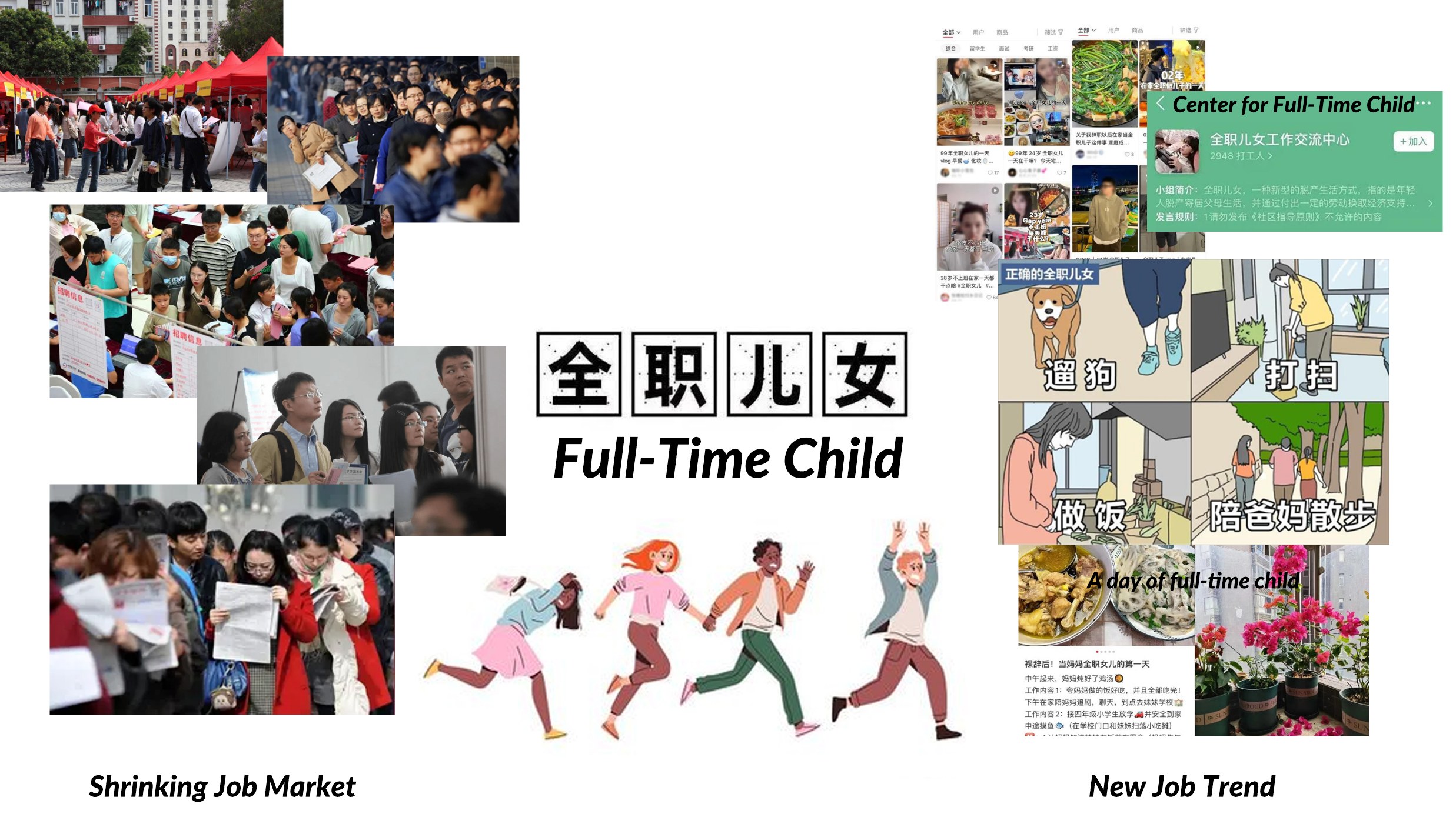
In China, “waithood” has taken on an intriguing transformation. On Chinese social media, there is currently a trending “job” known as being a “full-time daughter” or “full-time son.” These individuals are typically in their twenties, living at home, assisting with household tasks, spending time with their parents, and depending on their parents financially. Some are preparing for civil service entrance exams or applying to graduate schools, while others have been laid off and are waiting for other job opportunities or simply not engaged in any employment but are focused on accompanying their parents.
Accompanying their parents is the most crucial aspect of this “job.” Once, when my parents asked about my post-graduation plans, whether I intended to seek employment in the U.S. or in Guangzhou (it had to be Guangzhou and only Guangzhou), I mentioned my uncertainty about finding a job in the U.S., but I was willing to try. I jokingly brought up the recent trend of being a “full-time daughter” among those who had studied abroad, and my mother immediately expressed her happiness at the prospect of me staying at home to accompany her and becoming a “full-time granddaughter” to spend time with my grandma. Having been alone in the U.S. since I was 17, I understood my mother’s desire to spend more time with me and being a “full-time daughter” seemed like the perfect way to fulfill her wishes after all these years.
Observing other “full-time daughters/sons” on social media, I noticed that this trend is more prevalent in families with a strong financial foundation, particularly those who can support their children’s overseas education. Due to the shrinking job market in China, even graduates from prestigious universities may struggle to secure job offers. Moreover, those with international study experience often reject job offers that don’t meet their expectations. I joined a social media channel called the “Returnees Waste Recycling Mutual Aid Association,” which consisted of people who had returned to China after studying abroad. Some received low-paying job offers, while others didn’t receive any at all. Some had jobs but were dissatisfied with their lives, which wasn’t what they had envisioned after investing so much in their education abroad.
“Becoming a full-time daughter” has become an alternative source of income and support for them, as mentioned in Dawson’s work about young South African men. Dawson argues that their ability to refuse or exit low-wage jobs is connected to their access to alternative sources of income and support, often involving their relationships with their mothers and other women (Dawson, 2022).
Also, it’s fascinating to discover that I, too, have a desire to remain in a state of “waithood,” and many people in China share this sentiment. This resonates with Honwana’s statement that “waithood is becoming a more permanent state” (Honwana, 2014).
I began to question whether young women in “waithood” are trying to resist the social norms that prioritize marriage and motherhood. I also wondered whether people with study abroad experience should refrain from complaining about not receiving job offers because they refuse to settle for positions that fall below their expectations. I pondered whether China’s one-child policy played a significant role in the emergence of the “full-time daughter/son” trend.
Over the past decade, my parents invested a substantial amount of money in my education in the United States. I hold a B.S. degree in Landscape Architecture and am currently pursuing studies in Historic Preservation Planning at an Ivy League school. Surprisingly, my mother is delighted to appoint me as a “full-time daughter,” a role that seemingly doesn’t require a master’s degree. In contrast to societal norms, my mother seems to find contentment in the idea of me remaining in a state of “waithood” indefinitely. This has left me pondering her reasoning. She consistently emphasizes that her sole expectation for me is to be healthy and happy.
This leaves me with a new question: Is it truly challenging to attain health and happiness if I were to step out of the “waithood”?
References
Dawson, Hannah J. “Living, Not Just Surviving: The Politics of Refusing Low-Wage Jobs in Urban South Africa.” Economy and Society 51, no. 3 (July 3, 2022): 375–97. https://doi.org/10.1080/03085147.2022.2058742.
Honwana, Alcinda. “2 ‘Waithood’: Youth Transitions and Social Change.” In Development and Equity, 28–40. Brill, 2014. https://doi.org/10.1163/9789004269729_004.