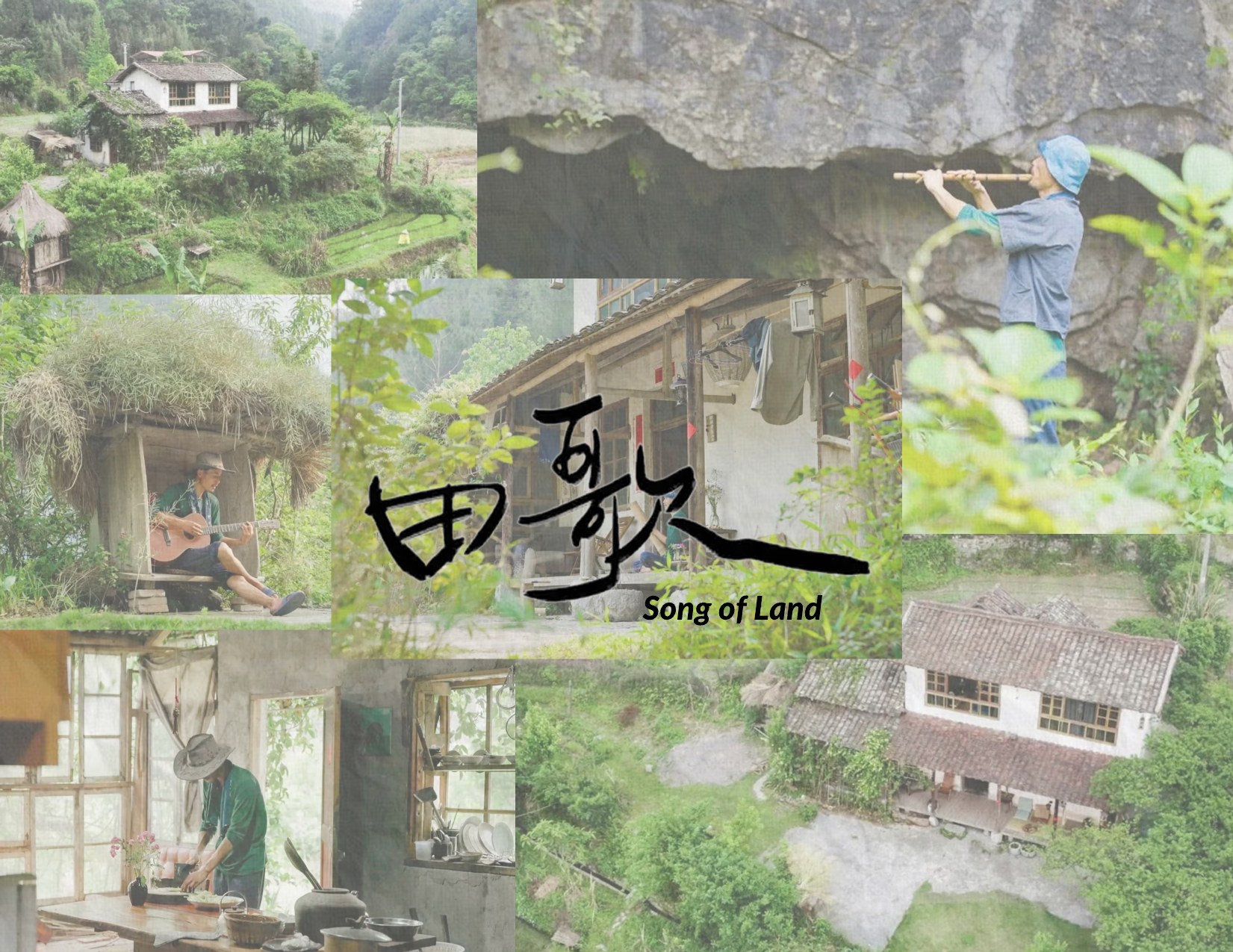
Song of Land 田歌
“Head Down to Farm, Head Up to Sing” — A Life After the City
There is a popular music variety show called “The Big Band” that began in August of this year. One of the bands in this show is “Wayina,” formed by three farmers. The lead vocalist, Banong, was born in a village in Guangxi, and had worked in several cities. Because they couldn’t afford expensive electronic music equipment, instead, they found solace in playing an acoustic guitar and even using leaves to create music.
In 2012, Banong quit his job in Guangzhou and returned to his hometown in Guangxi to start farming and building houses. In a short documentary about him, he expressed his doubts about the need to spend half a lifetime’s earnings on a beautiful home, citing a friend who had to work in the city for two years just to afford an entry door and two columns for his house.
Banong’s words resonate with young Black South African men who reject low-wage jobs in Dawson’s work. Banong, born in a village and having completed only community college, failed the art institute entrance exam four times. He shares similarities with the young Black South African men described in the article, as few of them have tertiary education (Dawson, 2022). Banong was also a hustler; during his city days, he dreamed of studying art at an institute. Despite his setbacks, he continued to work and pursue his hobby—music. He adapted to the reality of not affording expensive instruments and even used leaves to make music.
As Thieme suggests in her work, Banong, as an individual who was hustling, embodied uncertainty, off-grid living, and vulnerability, yet he possesses the agency to confront and perpetuate conditions of adversity simultaneously (Thieme, 2018).
When he voluntarily quit his job and returned to his hometown, he acquired 35 Mu of land (equivalent to 1/15 of a hectare) and an old house in need of repair. He gradually fixed his house using available resources, such as abandoned windows from neighbors’ houses or demolishing houses. Every day he farms and sings. He summed up his life as “head down to farm, head up to sing.” Whether from the documentary or the music he creates, it’s clear that Banong leads a simple and poetic life. He is no longer hustling, I think.
This led me to question why he can embrace this lifestyle. Could it be that he finds a sense of rootedness in his house and farmland, which may be unattainable in the city or during his previous work? Banong, born in a rural area, had experience with farming from a young age. From my perspective, returning home to do what he is familiar with seems like an asylum to him. Most importantly, he enjoys the life of farming; it’s not an escape from the city but a conscious choice to start a different life in his hometown.
I started to contemplate the situation of young individuals born in urban villages or informal settlements within the city. Where could they seek refuge? Perhaps they exist in a perpetual state of anticipation, trapped in a “tense endlessness” where something is always on the verge of happening, only to never materialize, leaving them in a constant state of limbo. They wait, continuously searching for alternative options like Banong’s, yet lacking the luxury of having farmland and an old house in their hometown, they find themselves trapped in their circumstances.
Banong says he doesn’t desire much, just “a bowl of porridge, a flute, and a moon” seem sufficient for life. However, for many people still hustling, even having three meals a day holds profound meaning. The beauty of the moon, too, may be a luxury for those whose work keeps them too busy to appreciate it. I’m not questioning Banong’s simple life; I’m merely pondering whether it offers an alternative choice for those struggling in the urban environment and stuck in waithood. Is it an exceptional example and a fairy tale for most people who are hustling?
Documentary exploration of the Hegang phenomenon and the search for stability.
References
Dawson, Hannah J. “Living, Not Just Surviving: The Politics of Refusing Low-Wage Jobs in Urban South Africa.” Economy and Society 51, no. 3 (July 3, 2022): 375–97. https://doi.org/10.1080/03085147.2022.2058742.
Thieme, Tatiana Adeline. “The Hustle Economy: Informality, Uncertainty and the Geographies of Getting By.” Progress in Human Geography 42, no. 4 (August 2018): 529–48. https://doi.org/10.1177/0309132517690039.