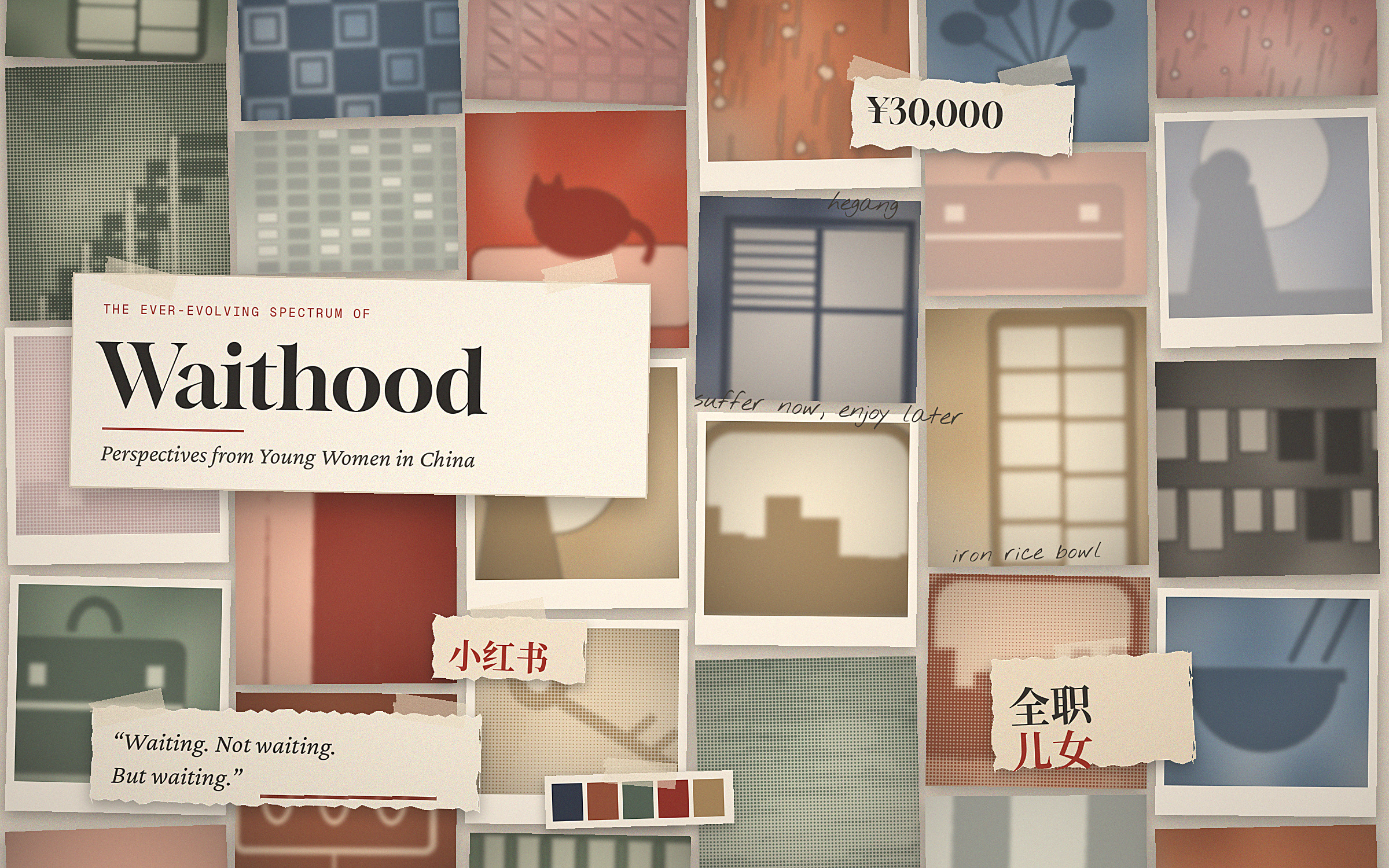
The Ever-Evolving Spectrum of Waithood
Perspectives from Young Women in China
Introduction
The young people of this generation are constantly in a state of waiting, and I am no exception. Some may be waiting for the opportunity to secure a proper job, some may be hoping for affordable housing, and others might not even be certain what their future holds. Waithood is not an isolated phenomenon; it is entwined with the spheres of work and housing.
In China, young people experience waithood while they are still in school. The educational institutions present a form of “cruel optimism,” creating a stark contrast between their offerings and the harsh realities of unemployment. This dissonance hinders youths from realizing their dreams of a better life (Levy and Dubinsky, 2023, p. 19). The education system, the state, and parents all emphasize a single path to success, centered around the GaoKao (China’s national college admission exam). Studying becomes more of a formal process than a means of personal growth (Cuzzocrea, 2019, p. 578). After graduating from college, another predefined path awaits them, which is the civil service entrance examination. However, this one-size-fits-all approach to success leaves many individuals who don’t conform to this system feeling stuck (Levy and Dubinsky, 2023, p. 18). Even those who do fit into this system and pass the examination may still find themselves in a state of limbo because the path to success does not necessarily lead to the expected adulthood.
In Charlton’s work “Spanning the Spectrum: Infrastructural Experiences in South Africa’s State Housing Programme,” the concept of a spectrum is employed to illustrate various ‘everyday infrastructural experiences’ related to housing that extend beyond mere endorsement or critique of the housing (Charlton, 2018). This paper will adopt the same concept of a spectrum to explore the notion of waithood and its connection to housing.
This paper will primarily delve into how young women in China navigate the challenges of housing and employment associated with waithood. Young Chinese women respond to waithood in various ways: they may confront it head-on, find themselves trapped within its confines, or seek alternative approaches to navigate this period of waiting. Waithood exists along a spectrum, and this paper aims to provide multiple examples of young people, particularly young women in China, to paint a comprehensive picture of waithood in China.
Embracing Affordability: Women Pursuing Homeownership in Lower-Tier Cities
Waithood encompasses the challenges of finding stable employment, securing the necessary resources for home acquisition – whether through purchase, construction, or rental – and shouldering the financial responsibilities associated with marriage and family formation (Honwana, 2014, p.33). In urban centers, the aspirations of homeownership, marriage, and building families often remain out of reach, leaving social recognition as adults a distant objective. Some individuals opt to address the housing-related aspects of waithood by relocating to cities with more affordable real estate markets, such as Hegang, a veritable haven for young people aspiring to own a home as a symbol of the adulthood they seek. Hegang, located in the northeasternmost part of China, offers houses priced at a mere ¥30,000, roughly equivalent to $2,500. Acquiring a home for such a modest sum was nearly inconceivable in major Chinese cities like Beijing, Shanghai, Guangzhou, and Shenzhen. In Hegang, one could establish themselves with a home, free from the looming burden of a mortgage – a stark contrast to the arduous efforts required to attain property ownership in metropolitan areas.
Despite diligent efforts to save money, many individuals still struggle to accumulate enough funds for a down payment. As poignantly expressed by an interviewee in Dawson’s work, no matter how diligently he toiled or how long he remained in his current job, it seemed unlikely to lead to the life he truly desired (Dawson, 2022). When young people are within the educational institution, teachers and parents often paint a rosy picture of the future and emphasize the GaoKao as the sole path to success. Some students remain unsure about their choice of major, and a significant portion lack a clear career path due to the prevailing social norm in China, which suggests that entering the civil service represents the most secure job, often referred to as an “iron rice bowl.” However, with skyrocketing housing prices, even those with such secure jobs struggle to afford the down payment, particularly in a shrinking economy.
Young individuals in China, who once toiled in bustling metropolises, find that city keeps them in the seemingly perpetual state of limbo, where they are waiting for their own home and for their desired life milestones to materialize. Their waiting is aptly described as “a tense endlessness, where something is always about to happen; and then it does not happen … in limbo. Waiting. Not waiting. But waiting” (Oldfield and Greyling, 2015, p.1103).
However, Hegang becomes a sanctuary of sorts for these young individuals. In a documentary, a young woman named Tingting was interviewed. She had previously worked in the city of Chengdu but decided to quit her job and use her savings to purchase a house and start her own business as a beautician in Hegang. When asked why she chose to move to Hegang on her own, she replied, “Housing, for sure. If I have the money, why would I leave Chengdu? Chengdu is great.” She was told she was exceptionally courageous, to which she responded that she didn’t consider herself courageous; she just needed money. She explained that owning a home provided her with a sense of security and stability.
Living in Hegang allows these individuals to realize their dream of homeownership. As Tingting indicated, Chengdu is appealing, and she would not have left if she had the means. She yearned for the urban life, but the weight of housing tilted the balance, prompting her to address the persistent housing issue. On the other hand, many young women also yearn for urban life, but they remain trapped in waithood, living in small rental homes and waiting for the day when they can own their own home in the future.
Metropolis Dreams and Challenges: Women’s Metropolis Waithood Experience
Living in a metropolis is the dream of many children who have grown up in rural areas. For many rural women, who are disproportionately underrepresented in higher education, securing access to it is a struggle against oppressive gender norms. Often, women from rural backgrounds can only attend college after an older sister has “gone out to work” to pay for the college tuition of her younger siblings, a sacrifice rarely required of male children (Howlett, 2020, p.192). Succeeding in the National College Entrance Exam, known as the Gaokao, can alter their fate. At the same time, it represents one of the few ways for them to escape the strong prevailing “traditional” culture in many rural parts of China that “values men over women” (zhongnan qingnü 重男轻女) (Howlett, 2020, p. 178).
These are young women who have exerted tremendous effort, often with tears and sweat, to make their way to urban centers. For most of them, starting their studies and careers in the city marks the beginning of a new life. They have been exposed to the “traditional” culture that places higher value on men since birth. Living and working in the city become ways for them to prove their worth. One interviewee in Howlett’s work explained, “I think that [girls work harder than boys because of] a disobedient attitude. China is a patriarchy, and girls want to prove their worth” (Howlett, 2020, p. 192).
Young women can more easily envision their ideal lives in the city, even if they cannot afford a house. In Lee’s work, she notes that African women were able to find a sense of belonging within their small four-roomed houses and take the first steps toward actively feeling ownership, belied the insecurity of tenancy they had before (Lee, 2005, p. 625). Similarly, young Chinese women grapple with housing insecurity and aspire to experience a sense of belonging in the city. However, their determination to break free from entrenched gender norms and embrace the urban lifestyle bolsters their resolve, helping them transcend this insecurity. They may tell themselves that enduring an undesirable environment is a form of “suffer now, enjoy later,” believing that they are saving money for the down payment on their dream house. There’s a shared hope that eventually, things will improve, although the path forward is not always clear (Cuzzocrea, 2019, p. 580).
A vlog, featuring a young woman working in Beijing where rent is exorbitant, offers a glimpse into her life. She has been living in a 32-square-foot room for three years, introducing her daily life with her cat. From the video, it’s evident that her small room is cozy and well-organized. She shares with her audience that she enjoys her life and feels comfortable with her living situation. Young women often adapt and adjust to their environment, much like the residents described in Caldeira’s work, who, when able to transform their houses, tend to be content (Caldeira, 2017, p. 13).
On social media, many young Chinese women motivate and support each other. As Sadruddin’s work illustrates, for Rwandan women, coming together at friends’ homes, in cafes, or at church served as a means to motivate and support each other while strategizing about their futures (Sadruddin, 2020, p. 168). The “Little Red Book” (xiaohongshu 小红书) is a social media platform widely used by young Chinese women to share experiences, such as saving money, decorating rental homes without causing damage, financial advice, study tips, career guidance, and more. Young Chinese women who find themselves stuck in waithood support each other and seek ways to overcome it. Their outlook combines optimism with anxiety (Masquelier, 2020, p. 102).
The high real estate market in metropolises is a distant dream for young women who have just begun their new lives in the city, often without family support. Some even anticipate sending money back to their families in the countryside, a common struggle, especially for those with younger brothers, due to the persisting “traditional” culture. Young women working in the urban areas are expected to provide financial support to help their brothers escape their own waithood, enabling them to purchase or build a house and get married. These brothers, the young men in the countryside also experiencing waithood, are financially dependent on their sisters. They use the money earmarked for down payments or improved living standards to end their own waithood by acquiring a new home and getting married. This situation bears resemblance to the young South African men described in Dawson’s work, who can refuse or leave low-wage jobs due to access to alternative income and support, often stemming from their relationships with their mothers and other women (Dawson, 2022). In this cultural context, the waithood of young men becomes an obstacle in the journey of waithood experienced by their sisters.
There is another noteworthy group of young women in China who choose to remain in the state of waithood but adopt alternative approaches, and their decisions are often influenced by the support they receive from their families, with a particular emphasis on the pivotal role played by their mothers. These women, rather than actively seeking escape from waithood, opt to remain within its confines, exploring unconventional paths that challenge societal norms and expectations.
From Waithood to Carehood: Redefining Waithood in Chinese Families
In China, the concept of “waithood” has undergone a fascinating transformation. A trending “job” on Chinese social media, known as being a “full-time daughter,” is gaining popularity. These women are typically in their twenties, living at home, assisting with household tasks, spending time with their parents, and relying on their parents for financial support. Some are preparing for civil service entrance exams or applying to graduate schools, while others have been laid off and are waiting for other job opportunities, or simply not engaged in any employment but are focused on accompanying their parents. The core aspect of this “job” is providing companionship to their parents. Based on observations on social media in China, this trend appears to be more prevalent in families with strong financial foundations, particularly those that can support their children’s overseas education. It’s also noteworthy in families with only one child or those not influenced by a “traditional” culture that places higher value on men than women.
Due to the shrinking job market in China, even graduates from prestigious universities may struggle to secure job offers. Moreover, those with international study experience often reject job offers that don’t meet their expectations. There is a social media channel called the “Returnees Waste Recycling Mutual Aid Association,” which consists of individuals who have returned to China after studying abroad. Some received low-paying job offers, while others didn’t receive any offers at all. Some had jobs but were dissatisfied with their lives, which did not align with the aspirations they held after investing so much in their education abroad. Engaging in low-paid, unskilled labor was considered both demeaning and potentially detrimental to their future (Masquelier, 2020, p. 89).
It’s also interesting to note that there has been a shift in the vocabulary associated with waithood in China. This change in terminology resonates with Bahn’s work, which highlights how a vocabulary of practice must continually and dynamically reveal forms of doing, moving, and acting, adapting to changing urban landscapes (Bahn, 2019, p. 15). The vocabulary used to describe waithood has evolved in response to shifts in the way young people approach their lives. Previously, the term “Kenlao (啃老)” was often used, which translates to “nibble the elders” and is essentially the Chinese equivalent of “NEET” (Not in Education, Employment, or Training). It carried a negative connotation, implying that young people were sponging off their parents’ resources.
With the emergence of the “full-time daughter” trend, the dynamics in the parent-daughter relationship have shifted. They resemble more of an employer-employee relationship, as parents pay their daughters for tasks such as housework, companionship, and assistance with various technological issues. These women undertake tasks akin to those of housewives but receive compensation for their efforts. They are not merely idly waiting for their parents or the government to intervene but instead creatively find solutions to everyday challenges (Honwana, 2014).
The “full-time daughters” live very much in the present, orienting themselves towards their current status as young people and the numerous lifestyle opportunities that being young provides (Cuzzocrea, 2019, p. 577). They receive a “salary” from their parents, eliminating the need to pay rent or utility bills. This affords them more flexibility to enjoy their social lives and more.
The concept of the “full-time daughter” resonates with Cuzzocrea’s work, which suggests that young people are granted a “moratorium,” a permission to decelerate and experiment with themselves (Cuzzocrea, 2019, p. 580). In the fast-paced urban environment, some young people choose to take a break, spend time with their families, and consider their future at a slower pace.
What’s intriguing is that some young women in China are actively choosing to remain in a state of “waithood.” This aligns with Honwana’s assertion that “waithood is becoming a more permanent state” (Honwana, 2014). Waithood entails grappling with the pressures of finding a stable job and securing the resources for housing (Honwana, 2014, p. 33). However, through the “full-time daughter” trend, accompanying their parents becomes their stable occupation, and they need not secure resources for housing as they are living in the home they will eventually inherit. These young women are finding an alternative way to challenge societal norms regarding adulthood. Marriage and motherhood remain significant markers of adulthood (Honwana, 2014). By choosing to become “full-time daughters” and staying in waithood, they are challenging societal norms that primarily define women’s worth based on their procreative contributions to the nation (Howlett, 2020, p. 195).
Conclusion
Housing and employment serve as the key facets of waithood, and young Chinese women’s attitudes and perspectives toward these elements provide a broader view of waithood in China. It’s important to understand that waithood is not a fixed state, and the spectrum is far more complex than a linear progression. It takes on various forms, with young women adapting and changing their approaches as they navigate this period in their lives.
Some young women choose to relocate to lower-tier cities in pursuit of affordable housing and a sense of belonging to address their housing-related waithood. Some of them might make significant efforts to realize their dreams in bustling metropolises, often experiencing periods of being stuck in waithood. However, their determination to break free from deeply entrenched gender norms and embrace an urban lifestyle bolsters their resilience, enabling them to overcome housing-related insecurities. There are also those who voluntarily opt to remain in a state of waithood.
Waithood is a dynamic practice, and these young women may change their minds at any moment. For instance, those who initially tackled their housing-related waithood in a place like Hegang might later become weary of life in a lower-tier city, decide to sell their house, and return to a metropolis. In doing so, they reenter the cycle of waithood, grappling with housing challenges while pursuing their dreams in the city, which may hold greater importance for them. Similarly, young women who originate from rural areas might reconsider and compromise by returning to their rural homes. Those who initially enjoyed living with their parents may decide to step out and challenge themselves once again.
These young women hold a dynamic scale in their minds, with housing, employment, and family taking varying degrees of importance at different points in their lives. Most importantly, they aspire to have the agency to make these decisions for themselves. Waithood, for them, is a continuously evolving journey where the balance of priorities shifts as their circumstances change.
Acknowledgement
It’s important to acknowledge that due to the limitations of the research and the examples provided in this paper, the spectrum of waithood is actually even more extensive and multifaceted. The experiences and approaches of young Chinese women in navigating waithood are highly diverse, and this paper only scratches the surface of this complex and evolving phenomenon. Further research and exploration are needed to fully grasp the intricacies and nuances of waithood in China.
References
Bhan, G. (2019). Notes on a Southern urban practice. Environment and Urbanization, 31(2), 639–654. https://doi.org/10.1177/0956247818815792
Caldeira, T. P. (2017). Peripheral urbanization: Autoconstruction, transversal logics, and politics in cities of the global south. Environment and Planning D: Society and Space, 35(1), 3–20. https://doi.org/10.1177/0263775816658479
Charlton, S. (2018). Spanning the spectrum: Infrastructural experiences in South Africa’s state housing programme. International Development Planning Review, 40(2), 97–120. https://doi.org/10.3828/idpr.2018.6
Cuzzocrea, V. (2019). Moratorium or waithood? Forms of time-taking and the changing shape of youth. Time & Society, 28(2), 567–586. https://doi.org/10.1177/0961463X18763680
Dawson, H. J. (2022). Living, not just surviving: The politics of refusing low-wage jobs in urban South Africa. Economy and Society, 51(3), 375–397. https://doi.org/10.1080/03085147.2022.2058742
Howlett, Z. M. (Ed.). (2020). Chapter 7: Tactics of Marriage Delay in China Education, Rural-To-Urban Migration, and “Leftover Women.” In Waithood: Gender, Education, and Global Delays in Marriage and Childbearing (1st ed.). Berghahn Books. https://doi.org/10.2307/j.ctv287sk5z
Lee, R. (2005). Reconstructing ‘Home’ in Apartheid Cape Town: African Women and the Process of Settlement. Journal of Southern African Studies, 31(3), 611–630. https://doi.org/10.1080/03057070500202998
Levy, N., & Dubinsky, I. (2023). Forever young: Institution-based waithood among youth in Ghana and South Africa. Time & Society, 0961463X231193143. https://doi.org/10.1177/0961463X231193143
Masquelier, A. (Ed.). (2020). Chapter 3: Waiting at the Fada Young Men, “Tea Circles,” and Delayed Adulthood in Niger. In Waithood: Gender, Education, and Global Delays in Marriage and Childbearing (1st ed.). Berghahn Books. https://doi.org/10.2307/j.ctv287sk5z
Oldfield, S., & Greyling, S. (2015). Waiting for the state: A politics of housing in South Africa. Environment and Planning A: Economy and Space, 47(5), 1100–1112. https://doi.org/10.1177/0308518X15592309
Sadruddin, A. F. A. (Ed.). (2020). Chapter 6: “Giving Oneself Time” Marriage and Motherhood in Urban Rwanda. In Waithood: Gender, Education, and Global Delays in Marriage and Childbearing (1st ed.). Berghahn Books. https://doi.org/10.2307/j.ctv287sk5z